PRP can help some people with thinning hair, mainly those with early pattern hair loss whose follicles are still producing hair. It is a course rather than a single appointment, it takes months to judge, and it does not work for everyone. The most useful thing a consultation can do is tell you honestly whether you are likely to be one of the people it helps.
Here is what actually happens, session by session, and how to judge whether it is worth your time.
What PRP for hair is
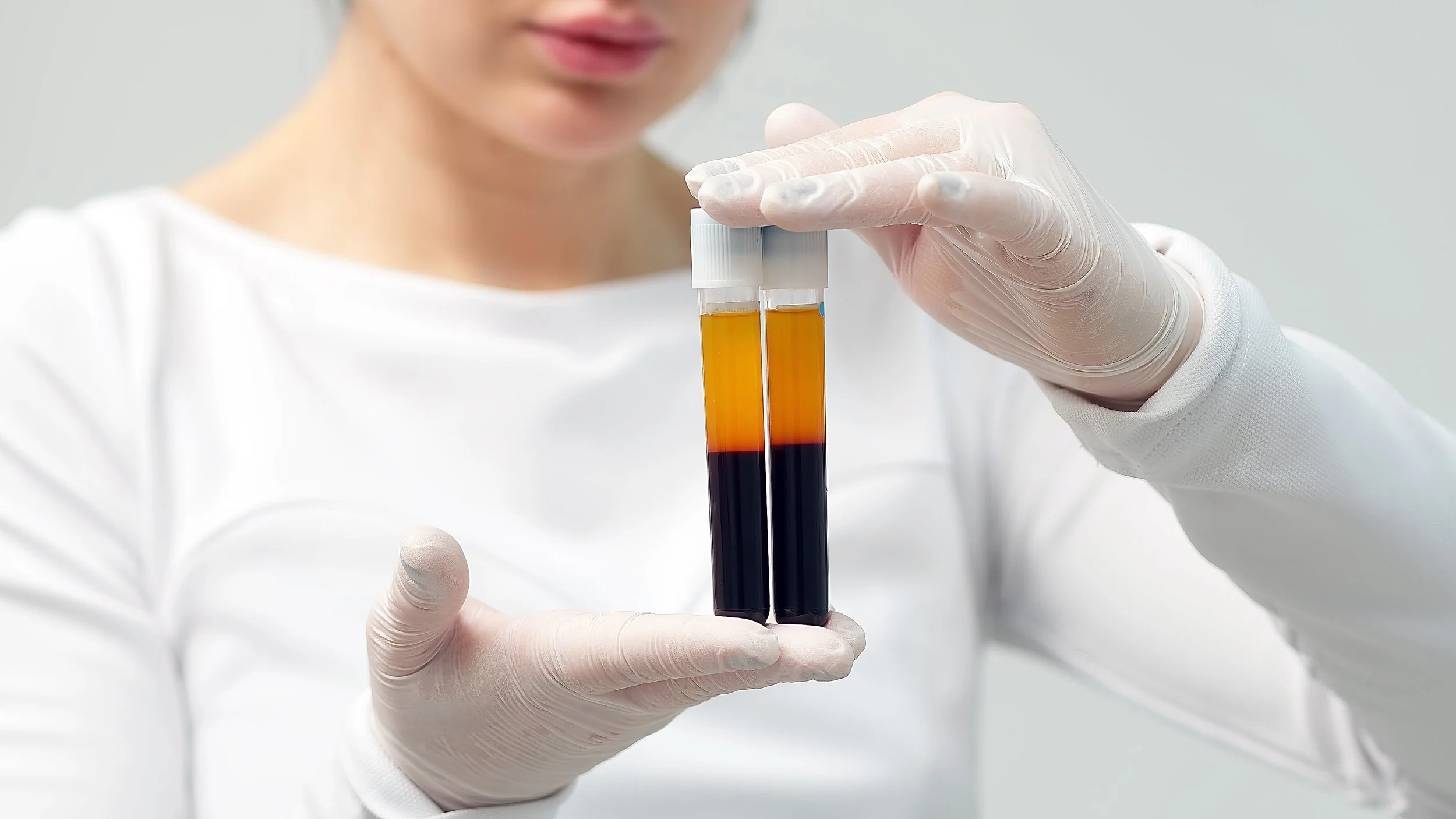
PRP stands for platelet-rich plasma. A small tube of your blood is drawn, much as it would be for a routine blood test, and spun in a centrifuge to separate the plasma and concentrate the platelets within it. Platelets carry growth factors, the signalling proteins your body uses to coordinate repair, and that concentrate is injected into the thinning areas of your scalp. Nothing synthetic is introduced. The active ingredient is your own blood.
On the scalp, PRP works on follicles that are still alive but miniaturising: the gradual shrinking seen in pattern hair loss, where hairs grow back finer and shorter over time. That is why timing matters more than almost anything else. It can support what is there. It cannot bring back what has already gone.
We will be straight about the evidence. For androgenetic (pattern) hair loss it is encouraging but mixed. Studies differ in how PRP is prepared and given, and people differ in how much, if at all, they respond. Where it does help, the benefit usually needs maintaining. PRP is not a substitute for finding and treating an underlying cause. There is more on the treatment itself on our PRP treatments page.
Who it tends to suit, and who it doesn't
PRP tends to suit people with early to moderate thinning: a parting that has slowly widened, a crown that is starting to show, or hair that has become finer over a few years while the follicles are still there. Thinning that becomes noticeable around the menopause is assessed in the same way: the question is whether it is pattern loss, and whether anything else is contributing.
It is not the right place to start in these situations:
Hair loss without a medical cause ruled out. Thyroid problems, iron deficiency, anaemia and some medications can all cause it, and are worth identifying before you spend money on PRP.
Scarring alopecia, where the follicles themselves are being damaged. That needs a diagnosis and medical treatment first.
Active scalp conditions: itching, burning, scaling, inflammation or infection, or patches of complete smooth loss. These need looking at rather than treating over.
Blood disorders, or medication that affects bleeding or clotting. We go through your medical history at consultation, and some conditions rule PRP out.
Pregnancy and breastfeeding.
Under-18s. We do not treat anyone under 18.
Shedding is a separate question. More hair in the brush after illness, childbirth, a stressful period or in autumn is usually temporary and settles on its own, and PRP is not the treatment for it. Our article on why hair sheds more in autumn, and when it isn't seasonal explains how to tell the two apart.
If we think PRP is unlikely to help you, we will say so at consultation rather than after three sessions.
What happens at each session
Every treatment is carried out by Dr Haroon Ashraf, a GMC-registered doctor who injects full time, and every appointment starts with a consultation with him.
Before you come in
You will be sent a medical questionnaire and consent form to complete beforehand, so the time in clinic is spent on you rather than on paperwork. If you take blood-thinning medication, tell us, and do not stop it on your own.
On the day
The first appointment starts with your history (how long the thinning has gone on, how it began, whether it runs in the family, and any recent illness, medication or blood test results) and an examination of your scalp, because the pattern of thinning is what decides whether PRP is a reasonable option. We photograph your scalp so later sessions can be compared against something more reliable than memory.
A small tube of blood is then drawn from your arm and spun to isolate the platelet-rich plasma, which Dr Ashraf injects into the thinning areas of the scalp. The whole appointment takes around forty-five minutes, including the draw and the spin, and most people go back to their day afterwards. Later sessions follow the same steps. Our PRP page has a short video of Dr Ashraf explaining the process.
Aftercare
You will have written aftercare before you leave, and Dr Ashraf's direct contact details if anything concerns you. The general advice is:
Leave your hair unwashed until the following day, and try not to touch or scratch the treated areas in the meantime.
Avoid saunas, steam rooms and strenuous exercise for a day or two.
Hold off on colouring, perming or other chemical hair treatments for a few days.
If your scalp is tender, ask us which pain relief to take, as anti-inflammatory painkillers are usually avoided for a few days after PRP.
Contact us if anything is getting worse rather than settling, such as increasing pain, heat, swelling or discharge.
How many sessions, and how far apart
PRP is a course, not a single session. Scalp treatment usually runs to three sessions a month apart, followed by maintenance every six to twelve months. Single sessions and courses of three and six are listed on our pricing page, and the number of sessions you have is agreed with you at consultation.
Maintenance is part of the plan, not an afterthought. Pattern hair loss does not recover on its own, so where PRP helps, the benefit tends to fade gradually without top-up sessions. Whether maintenance is worth it for you is something to judge once the course is complete.
When you might notice a difference
Not on the day, and not after the first session. Results build slowly because you are waiting on your own biology, and the honest timeline is three to six months before you can fairly judge it.
The reason is the hair growth cycle. Follicles move through a long growing phase, a short transition and a resting phase before the hair is shed and a new one starts, so even when a follicle responds well, the new hair needs months of growth before it makes a visible difference.
For people who do respond, the first change is often less hair coming out, followed later by hair that looks and feels thicker, particularly along the parting or at the crown. Some see a clear change; some a modest one, easier to spot in photographs than in the mirror, which is one reason we take them. Some see no meaningful difference, and if that is you at the end of a course, we will tell you rather than suggest more of the same.
Results are individual, and nobody can tell you in advance how much difference PRP will make for you.
Side effects and risks
PRP is a medical procedure, and it carries medical risk. Because the material is your own blood, allergic reaction is not a concern in the way it is with an introduced product, but that is not the same as no risk at all.
Common and expected. Redness for a day and mild tenderness on the scalp. A feeling of tightness or a mild headache on the day. Small bruises at the injection points or where the blood was taken.
Uncommon. Swelling of the scalp, which occasionally settles down towards the forehead for a day or two. Feeling faint during or after the blood draw. Both settle on their own.
Rare and serious. Infection is rare but possible with any injection. It is recognised early and managed properly by a doctor who knows what he is looking at, which is the point of having one.
Dr Ashraf is a senior clinical trainer at Derma Medical, and over 1,000 doctors, dentists and nurses have been trained by him in injectable technique and complication management.
What it costs
PRP for hair is listed on our pricing page as hair rejuvenation:
One session: £300
Three sessions: £750
Six sessions: £1,400
The plan, the number of sessions and the price are agreed with you before anything is booked, and there is no obligation to go ahead on the day. Because PRP is a course followed by maintenance, it is worth thinking about the cost over a year rather than per session. Prices for every treatment are on our pricing page.
How it fits with other hair-loss treatments
PRP is one option among several, and for many people not the first. Pattern hair loss has established medical treatments, topical and prescription, which work differently from PRP and are a sensible choice for the right person. PRP is not a reason to avoid them.
That is why we recommend a proper medical assessment first. If there is an underlying cause, treating it matters more than treating the hair. If it is pattern hair loss, PRP can be used on its own or combined with medical treatment where that is appropriate. If you are already using a treatment that is working for you, do not stop it without speaking to whoever prescribed it.
Where follicles have gone, a hair transplant is a separate conversation, and PRP is not a substitute for one.
PRP is also used on the face, for skin quality rather than hair, and our guide to what a PRP facial does for your skin, and what it doesn't covers that. For both treatments, see our PRP page. To talk through your own hair loss, you can book a consultation with Dr Ashraf.
Questions we're asked
Does PRP work for everyone with thinning hair?
No. It works on follicles that are still alive but miniaturising, so it suits early pattern hair loss better than advanced loss, and even then responses vary. If we think it is unlikely to help you, we will say so at consultation.
Can PRP help with shedding after having a baby?
It is usually not the answer. Shedding after childbirth, illness or a stressful period typically follows the trigger by two to three months and is almost always temporary, so identifying the trigger is more useful than treating the hair. If shedding has continued for more than six months, or the pattern is uneven rather than all over, that is the point to have it assessed.
What happens if I stop having PRP?
Any benefit tends to fade gradually, because the pattern hair loss underneath carries on. That is why a course is usually followed by maintenance every six to twelve months. Stopping does not damage your hair; it simply returns to the course it was already on.
Where are you based?
3 Holmesdale Road, Reigate, Surrey RH2 0BA, a minute from Reigate station and about ten minutes from junction 8 of the M25. We are open seven days a week by appointment, and patients come to us for PRP from across Surrey, including Redhill, Leatherhead, Dorking, Banstead and Horley.